Protecting Gulf Coast Assets with the Right Marine Welding Partner
Marine equipment along the Gulf Coast works hard every single day. Barges, docks, loading racks, and waterfront structures take constant abuse from saltwater, sun, heavy loads, and busy traffic in ports and shipyards. When late summer rolls around and storm season ramps up, weak welds are the last thing anyone wants to worry about.
Poor marine welding does not just look bad. It can lead to unplanned downtime, safety incidents, code issues, and shorter life for expensive assets. A cracked weld on a barge ramp or a failed ladder bracket can interrupt operations and put people at risk.
In this article, we share a clear way to evaluate marine welding contractors for Gulf Coast projects. Our goal is to help project owners, facility managers, and marine contractors find partners who can bring shop-quality welding out to the dock, the yard, or offshore when it matters most.
Understanding Marine Welding Demands on the Gulf Coast
Marine welding along the Gulf Coast is not the same as basic structural work inside a dry shop. The local environment pushes metal and welds to their limits.
Salt spray, high humidity, and warm Gulf waters speed up corrosion and fatigue. Steel that might last a long time inland can start to pit and thin much faster near the water. By late summer, when storm activity and heavy swells are more likely, welds on barges, bulkheads, pilings, walkways, and structural steel face even more stress.
Marine work also brings more technical demands. Welders must handle:
- Different metals, such as carbon steel, stainless steel, and aluminum
- Dynamic loads from waves, tides, and vessel movements
- Constant exposure to spray and standing water
- Tight spaces, awkward positions, and overwater access
Welds for hull repairs, deck structures, ladders, catwalks, and pipe systems need procedures that match the service conditions, not one-size-fits-all settings. For example, a repair on a barge side shell will have different needs than a handrail on a loading rack or a pipe tie-in at a terminal.
There is also the regulatory side. Marine work often overlaps with expectations from the Coast Guard, OSHA, and port authorities. While every job is different, owners should expect welds that are informed by relevant codes and safety rules. Knowing these demands helps you ask sharper questions when you screen welding contractors for your marine projects.
Verifying Marine Welding Certifications and Code Compliance
A strong marine welding contractor does not guess their way through a repair. They work from proven procedures and documented qualifications.
Key things to ask about include:
- Use of AWS and ASME code-compliant welding procedures
- Welders certified for the processes and positions needed on your project
- Familiarity with common structural and aluminum codes, such as D1.1 and D1.2 where applicable
- Written Welding Procedure Specifications (WPS) and supporting Procedure Qualification Records (PQR)
A clear WPS is the roadmap to repeatable weld quality. It covers items like process, filler metal, base metal, joint design, and required preheat or interpass temperatures. For Gulf Coast marine work, this kind of control is especially important due to corrosion and loading.
Inspection and testing are just as important as making the weld. Depending on project risk level, you might see:
- Visual inspection during and after welding
- Dye penetrant testing for cracks on stainless or aluminum
- Magnetic particle testing for surface flaws on steel
- Ultrasonic or radiographic testing for critical structural or pressure welds
Good contractors keep traceable documentation, such as inspection reports, welder certifications, and material certs. These records can support audits, insurance requirements, and future maintenance planning.
Safety and compliance culture should never be an afterthought. In marine environments, work often happens over water, at height, around active equipment, and in tight windows. It is fair to ask for:
- A history of safe work performance
- Ongoing safety and skill training for field crews
- Sample Job Safety Analyses or method statements for overwater or elevated tasks
A contractor that takes safety planning seriously is far more likely to protect both people and assets.
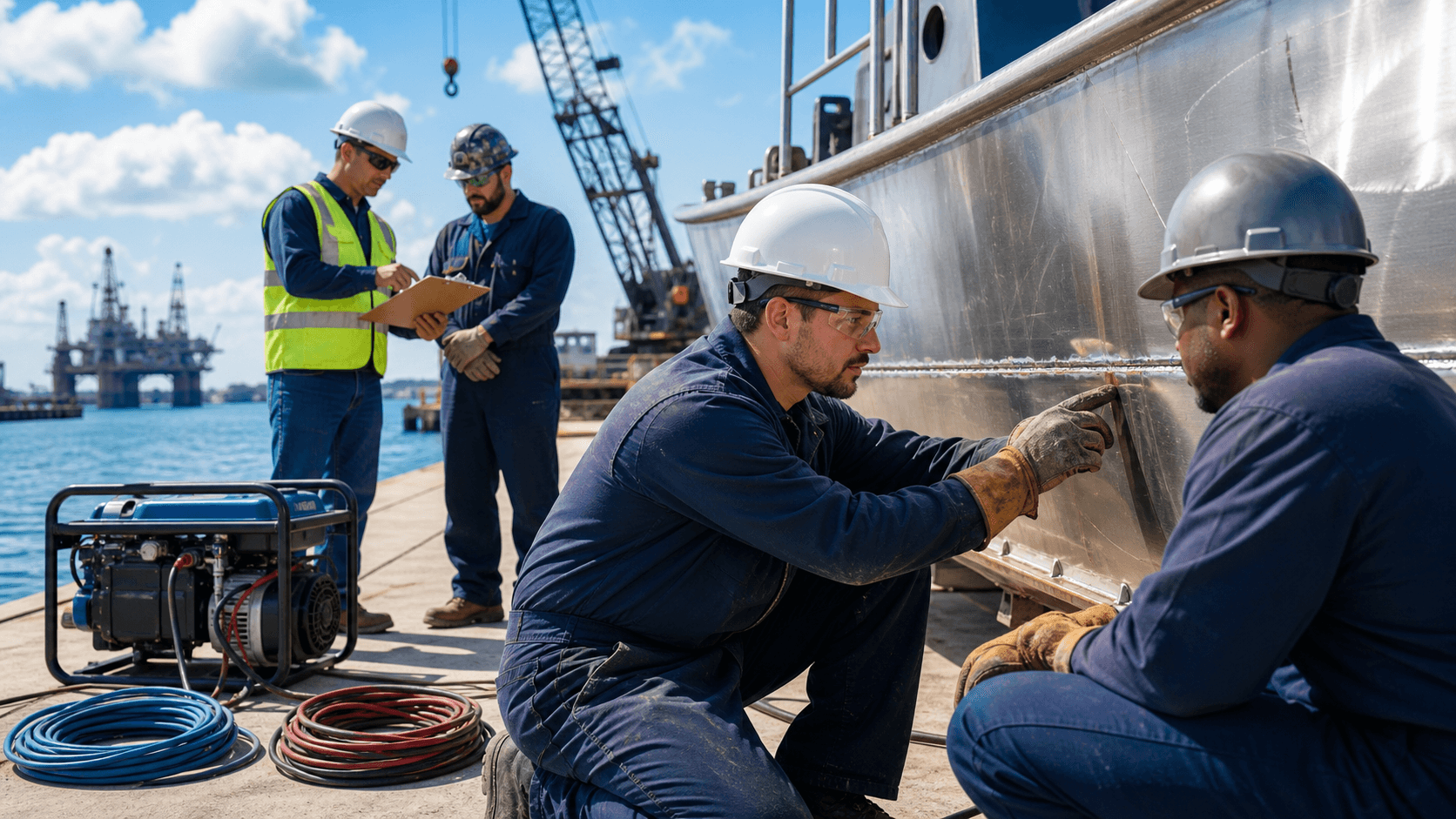
Evaluating Mobile Capabilities for On-Site Marine Projects
Not every field welder is ready for demanding marine work along the Gulf Coast. There is a big difference between a basic truck with a welder on the back and a true mobile welding unit set up to bring shop-quality results to the waterfront.
A strong mobile marine team can bring:
- Reliable power generation sized for welding, cutting, and tools
- Cutting options like oxy-fuel or plasma, as suitable for the job
- Rigging and fit-up tools to handle heavy or awkward pieces safely
- Portable positioners or stands to get good weld access in tight or elevated zones
On the water, logistics can be just as hard as the welds. Contractors should be ready to deal with:
- Limited access via barge, dock, or narrow roads
- Small laydown areas and tight work envelopes
- Changing tides and vessel movements
- Coordination with port, shipyard, or terminal operations
During late-summer storm season, availability matters. Many owners want contractors who can mobilize quickly for emergency repairs or pre-storm reinforcements, even at odd hours. A team that can also support planned outages or shutdowns for more controlled work gives you options year-round.
Another big plus is when the same contractor can fabricate in a shop, then bring those finished pieces out for field fit-up. That kind of shop-to-field continuity can:
- Improve fit on structural steel, ladders, platforms, and handrails
- Cut down on cutting and rework at the dock
- Shorten outage windows for piers, docks, and nearshore facilities
Assessing Experience, Materials, and Project Fit
Marine welding experience is not just about years; it is about the right kind of projects. For Gulf Coast work, you want a contractor who can point to successful projects with items like:
- Barges and tugs
- Docks, bulkheads, and fender systems
- Loading racks, catwalks, and access structures
- Nearshore industrial sites and waterfront terminals
When speaking with potential partners, ask for references that can discuss performance in harsh weather, tight shutdown schedules, and live marine environments. You are looking for proof that the team can work efficiently without disrupting operations more than needed.
Materials and corrosion strategies are another key piece. Marine contractors should be comfortable with:
- Carbon steel for structures and supports
- Aluminum for lighter marine components
- Stainless steel for corrosive service areas and process piping
Good welders think beyond just making a joint. They plan for service life by focusing on:
- Proper joint design that sheds water instead of trapping it
- Filler metals compatible with both the base metal and the environment
- Coordination with coatings, galvanizing, or cathodic protection systems
Finally, match the contractor to the risk level of your project. Minor deck repairs, small brackets, or non-critical attachments do not carry the same risk as main structural supports, crane pedestals, or pressure piping. It helps to talk openly about:
- Which work can be phased around operations
- Which items must be done in planned outages
- Where value engineering might improve future access or reduce future repairs
Turning Contractor Interviews Into Confident Selections
Once you narrow your list of marine welding contractors, the interview stage is where you can separate talk from real capability. Go in with focused questions, such as:
- What codes and standards govern the marine welding on this project, and how do you comply?
- Can you walk me through a recent Gulf Coast marine job similar to ours?
- How do you handle emergency work during hurricane season and other high-risk periods?
- What inspection and testing steps do you plan for our critical welds?
- How do you manage safety for overwater and elevated work zones?
As you listen, watch for clear red flags:
- Vague or generic answers about WPS and PQR
- Few or no marine references in the Gulf Coast region
- Hesitation to share sample inspection reports or documentation
- Light attention to safety planning or personal protective equipment
On the other hand, green lights include:
- Specific descriptions of past barge, dock, or terminal projects
- Clear processes for quality control and code compliance
- Evidence of working smoothly with engineers, inspectors, and port staff
- Straightforward communication about logistics, access, and schedule limits
Owners and managers along the Texas Gulf Coast gain a lot by reviewing current marine welding providers before late-summer storms pick up. A proactive inspection of key welds, supports, ladders, and access points can reveal issues before they turn into emergency shutdowns. When you are ready to bring in a certified mobile welding and fabrication crew that can deliver shop-quality marine welding at your site, a company like Weldit can help keep your assets working hard on the water.
Protect Your Vessel With Certified Marine Welding Experts
If you are ready to safeguard your vessel with reliable structural and safety-critical repairs, our certified team at Weldit is here to help. Learn how our marine welding services meet demanding maritime standards for strength, durability, and compliance. We will review your project needs, provide straightforward recommendations, and deliver work that holds up in tough marine environments. To discuss timelines, specs, and scheduling, simply contact us today.