Keep Production Running with Smarter Weld Repair Choices
Keeping units online while still repairing problems is a daily balancing act in Houston plants. Every weld repair choice affects safety, production, and inspection risk. The big question is simple: can we fix this in-service with onsite mobile welding, or do we need to plan an outage and shut it down in a controlled way?
We find that good decisions come from a clear, repeatable framework. When engineers, inspectors, and welders all look at the same set of factors, it is easier to pick the safest and most practical repair path. In this article, we walk through four pillars that help answer the in-service versus outage question: system criticality, code and jurisdiction limits, isolation and LOTO feasibility, and NDE and access requirements. Our goal is to give your team a field-ready way to think through repair options while the plant keeps running through summer demand.
Start with System Criticality and Process Risk
Before anyone strikes an arc, we start by ranking how risky the system is if something goes wrong. Not all lines and equipment should be treated the same. A pinhole in a low-pressure utility line is not the same as a thinning spot on a high-pressure hydrocarbon header.
Many plants sort systems roughly like this, from highest concern to lower concern:
- High-pressure steam and high-energy gas lines
- Process piping in flammable, toxic, or high-temperature service
- Pressure vessels and reactors
- Storage tanks and flare lines
- Structural steel that supports equipment or pipe racks
- Secondary and utility systems, like water, air, or drains
The more severe the consequence of failure, the harder it is to justify in-service welding. We also look at process hazard and the operating envelope. Key questions include:
- Is the fluid flammable, toxic, corrosive, or very hot?
- How close is the work to ignition sources or occupied areas?
- What did previous MOC, PHA, or LOPA work say about this system?
If risk studies and procedures already treat a system as high concern, we lean toward planned outages for repairs. We also think about production and regulatory impact. For example, units that feed multiple downstream trains, emissions controls, or safety systems that regulators watch closely often deserve a shutdown-based repair rather than an in-service fix. When the whole site depends on that system, it is usually better to slow down on purpose than to rush an online repair.
Code Rules and Jurisdictional Limits on In-Service Repairs
After risk, the next pillar is code. Plant teams work inside a web of standards like ASME piping and vessel codes, API inspection codes, and the National Board rules for repairs. These documents set the ground rules for what counts as a temporary or permanent repair, and when an in-service weld is even allowed.
In general, we see in-service repairs approved more often for things like:
- Welded sleeves on piping, when designed per code and inspected
- Fillet weld attachments that do not pierce the pressure boundary
- Clamp-and-weld style composite or reinforcement repairs
- Build-up welds to restore wear areas, if procedures and heat input are controlled
Each of these has strings attached. Qualified welding procedures, proper preheat, PWHT when required, and agreed inspection steps all have to be in place. Owner requirements and insurer rules also matter. Some plant standards are stricter than the base code and simply do not permit certain online welds.
There are also hard stops. If the code, insurer, or jurisdictional authority of that boiler or pressure vessel says the system must be depressurized, drained, or hydrostatically tested after repair, then an outage is on the table. Internal inspection requirements are another clear line. If an inspector needs to see the inside surface or weld from the inside, then a controlled shutdown becomes part of the plan, even if onsite mobile welding skills could physically reach the defect from outside.
Isolation, LOTO, and Onsite Mobile Welding Feasibility
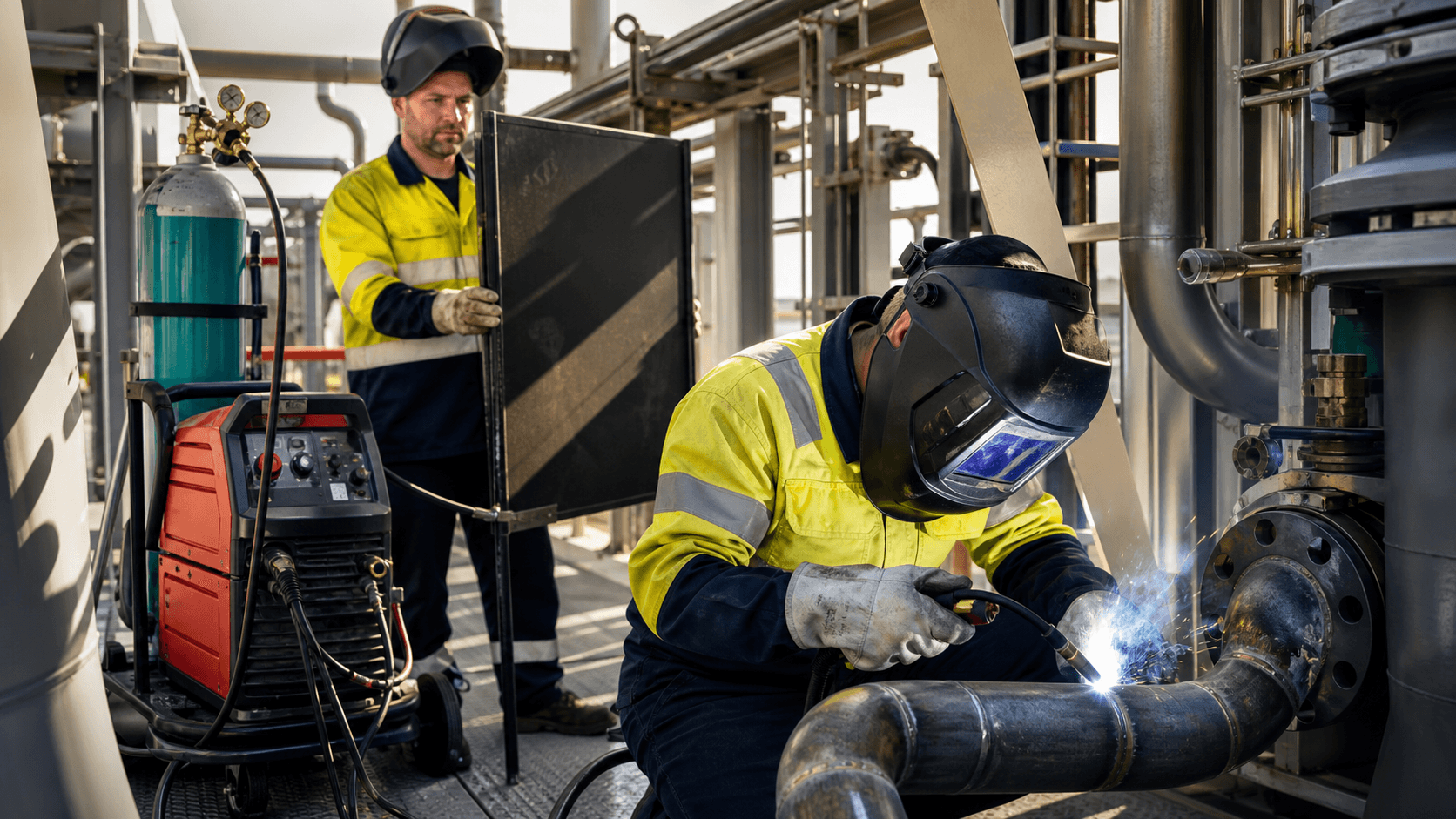
Even if the code allows an in-service repair, we still need safe isolation and energy control. For any hot work on or near a live system, reliable isolation is the gate that either opens the door for onsite mobile welding or closes it.
We work with plant teams to look at options like:
- Double-block-and-bleed on valves, with proven bleed paths
- Temporary blinds and line breaks, if access and spacing allow
- Line freezing setups, when approved by plant procedures
- Temporary bypasses that keep flow going around the work area
If none of these can give high confidence that the weld area is really isolated, then the in-service option quickly loses appeal. LOTO is tied to this. Energy control procedures, detailed tags, and clear drawings help everyone know what is actually safe. Gas testing, fire watch staffing, and hot work permits all support the decision too. If the hot work permit process flags high gas readings or poor ventilation, that alone can push a repair to a shutdown.
Then there is simple practicality. Onsite mobile welding must be physically possible. We look at:
- Access for welders, leads, and cables
- Wind, humidity, and summer sun exposure on the work area
- How close heat will be to gaskets, valves, or instruments
- Space for screens, fire blankets, and fire watches
Experienced crews find ways to work in tight spots, but some areas just cannot be reached safely while everything is live. When that happens, planning an outage section by section is often the smarter choice.
NDE, Access, and Inspection Requirements After Repair
Even a perfect weld is not done until inspection is complete. The type of NDE required can tip the scale between in-service and outage work. For example, if the repair calls for radiography on a crowded pipe rack, the radiation safety and access limitations may point toward waiting for an outage window when the area can be cleared.
Common NDE methods that drive repair planning include:
- Radiography on full-penetration welds
- UT or phased array for thickness and flaw sizing
- PT or MT to catch surface-breaking defects
- Visual inspection with good lighting and access
Internal versus external access also matters. Removing insulation, building scaffolding or setting a manlift, and dealing with confined space rules may be easier with the unit down and quiet. Some vessel welds and nozzles simply cannot be examined to code requirements while hot, under pressure, or full of product.
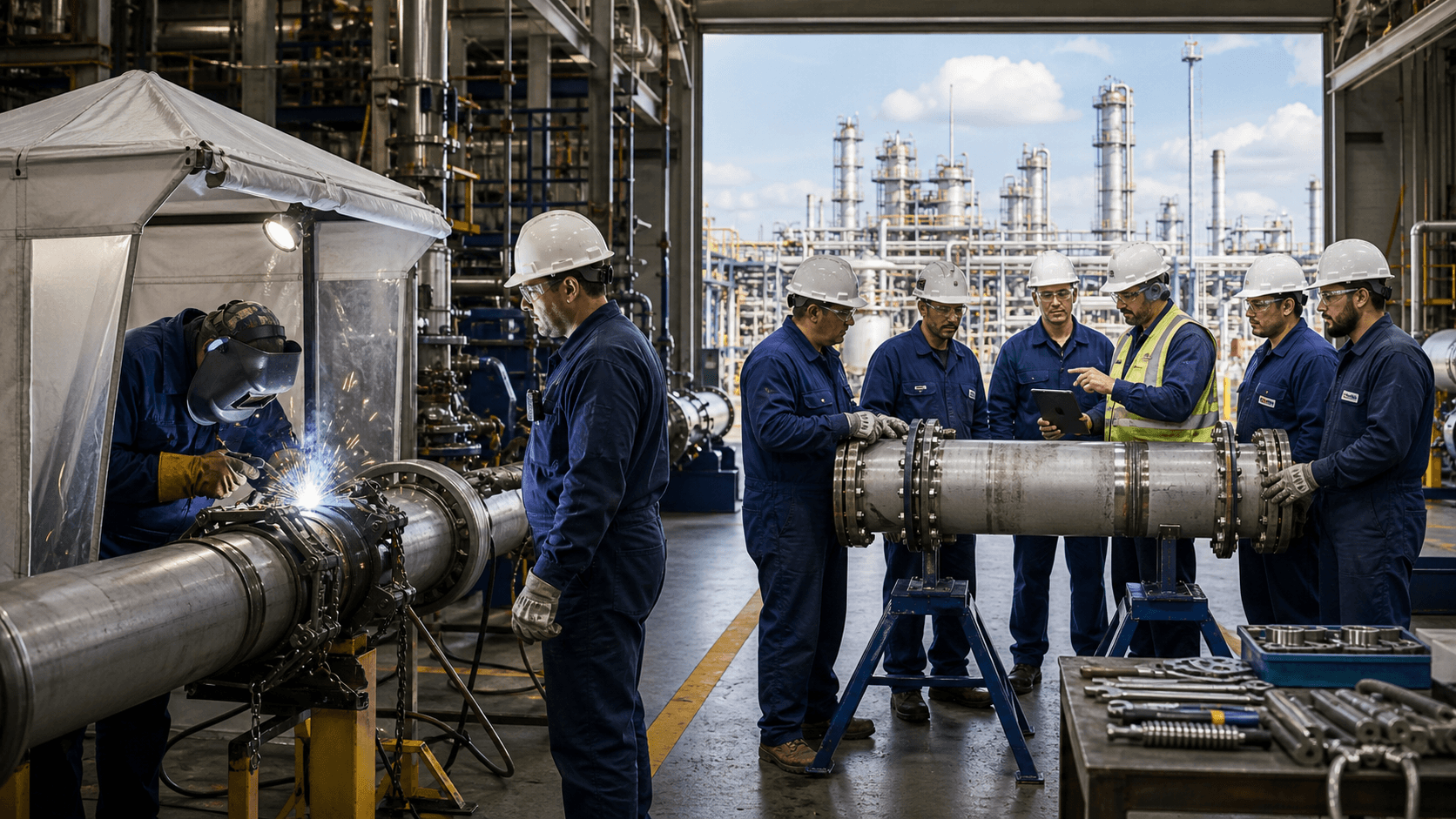
Post-repair checks close the loop. Pressure tests, leak checks, and re-baseline UT scans all take time and planning. When inspectors and mobile welding teams talk early, they can line up the repair scope, NDE methods, and test steps so the plant does not face rework or an extra shutdown just to prove the weld is good.
Turning the Framework Into a Field-Ready Decision Tool
The goal is to make all of this simple enough to use in the field. Many Houston plants build a quick checklist around four filters for any weld repair idea:
- System criticality and process risk
- Applicable code sections and owner or insurer rules
- Isolation and LOTO plan that is actually workable
- NDE and access plan, from weld to final inspection
If the answer is weak on any one of these, it is a signal to slow down and think outage. Before peak summer demand, some sites run reliability walkdowns and flag common problem areas, then set up a playbook of repairs that are pre-approved for in-service work. That planning makes it easier to say yes or no quickly when a defect pops up.
Teams that pair this kind of framework with skilled onsite mobile welding support can respond faster when problems show up in the heat of production season. With clear rules and shared expectations, it becomes much easier to know which welds can safely happen online and which should wait for a controlled shutdown.
Get Started With Your Project Today
If you need reliable onsite mobile welding, Weldit is ready to come to your location and get the work done efficiently and safely. We bring professional equipment and experienced welders directly to you so you can keep your project on schedule. Tell us about your repair or fabrication needs and we will recommend the right approach. Reach out today through our contact page to schedule service or request a quote.