Unplanned downtime during a restart hurts more than almost anything else in a plant. Most of that pain does not come from how many pipe welds you make; it comes from the handful that fail, get cut out, and ripple through your schedule. When a bad weld is buried in tight steel, behind insulation, or in a congested rack, every rework hour hits your restart date.
In modern industrial pipe welding, the old "weld it, then inspect it when we can" pattern is simply too slow. Tight outage windows, complex tie-ins, and high-consequence services demand a different approach. Here in Greater Houston and across Texas, summer turnarounds and heat-driven production needs put even more pressure on every outage. In this article, we walk through how a structured weld quality program, built on smart hold points, NDE sampling plans, and weld mapping, can cut rework and help your units restart faster and safer.
Turn Pipe Weld Quality Into Faster, Safer Restarts
Quality is not just about passing inspection, it is about protecting your restart date and your people. Every time a weld fails late in the outage, it creates:
- Extra hot work and fit-up in already congested areas
- Delays to hydrotests and leak checks
- Lost time while teams argue about cause and responsibility
Traditional sequencing waits until after the weld is finished to look for problems. By that point, the wrong filler metal, a bad fit-up, or a missed preheat step may already be baked into dozens of welds. Rework stacks up right when all eyes are on the restart clock.
A better way is to treat weld quality as a project tool, not just a code box to check. With planned hold points, risk-based NDE, and clear weld mapping, you can catch pattern issues early, keep inspectors and welders aligned, and give your restart team clean, traceable piping to turn back on.
Build a Weld Quality Program Around Risk, Not Habit
Many plants still lean on habits: generic WPS binders, "we always X-ray this much," and inspection that shows up when someone calls. That is checkbox quality. It might squeak by, but it does not protect the schedule.
A modern weld quality program for industrial pipe welding should include:
- Risk-based planning for lines and services
- Written, practical procedures that crews actually follow
- Qualified welders who are current on those procedures
- QA and QC tied directly into the work plan
Instead of treating every line the same, group systems by consequence of failure. For example,
- High-pressure steam or high-temperature services
- Hazardous or toxic chemicals
- Firewater, instrument air, and other critical utilities
- Low-pressure drains or vents with low consequence
High-consequence lines deserve tighter controls and faster feedback loops, such as more NDE and extra hold points. Lower-risk lines can still be safe and code-compliant with a lighter touch. The key is to agree on this with the owner, the applicable ASME or API codes, and the inspector before the outage starts. When everyone is aligned early, the first rejected weld does not turn into a rules debate in the field.
Use Smart Hold Points to Catch Problems Before They Multiply
Hold points are planned pauses where work stops until an inspection or check is complete. In pipe fabrication and field welding, they are where you slow down on purpose so you can go faster overall.
Useful hold points on downtime-sensitive projects often include:
- Material verification before fit-up starts
- Fit-up inspection before the root pass
- Visual checks between passes on critical joints
- Final dimensional and support checks before hydrotest
Too few hold points, and one small mistake can repeat across an entire rack. Too many, and you choke production and frustrate everyone. The trick is to focus hold points where the risk is highest.
Risk-based hold point ideas for plants and midstream work might include:
- Extra fit-up checks on high-stress elbows and reducers
- Root pass sign-off at tight tie-ins that will be hard to reach later
- Joint configuration verification where multiple wall thicknesses or materials meet
By lining these up in the plan, welders know when to call for inspection, inspectors know where to be, and you avoid "drive-by" quality that misses the real trouble spots.
NDE Sampling Plans That Protect the Schedule and the Asset
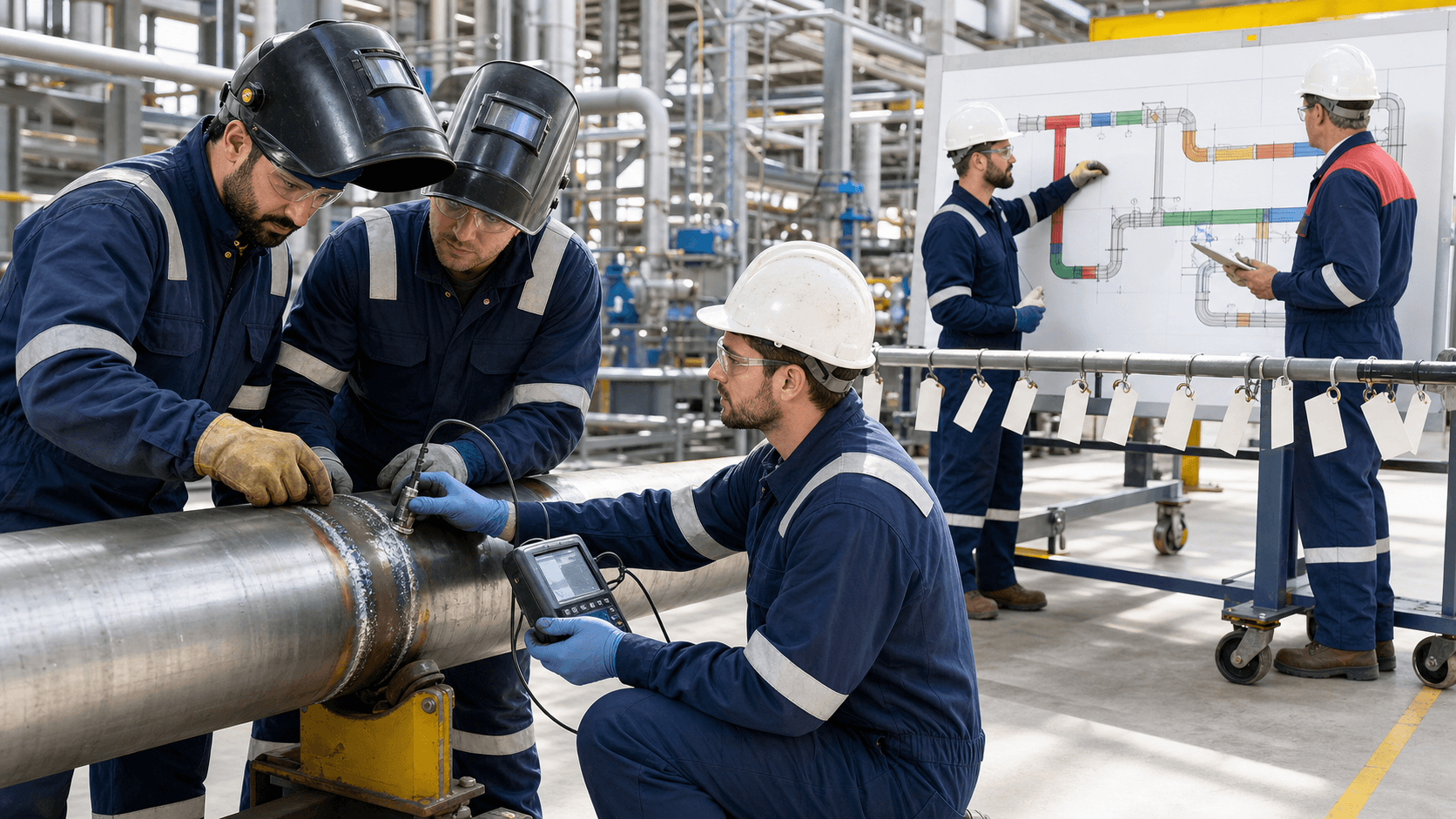
Nondestructive examination, or NDE, lets you look inside or on the surface of a weld without cutting it out. Common methods for industrial pipe welding include visual testing, radiography (RT), ultrasonic testing (UT), magnetic particle testing (MT), and liquid penetrant testing (PT).
A smart NDE sampling plan lines up with:
- Code minimums from ASME, API, or the project spec
- Owner requirements for key services
- Actual risk of the system and weld type
High-risk services and new or changed weld procedures may get higher NDE percentages and more UT or RT. Lower-risk lines may get less, but still placed where defects are more likely, such as welds in awkward positions or tight fabrication.
Good programs also use dynamic sampling. For example:
- If reject rates climb, you temporarily increase NDE on that welder, procedure, or line class
- If results stay clean and stable, you may reduce NDE toward the agreed minimum, never below code or contract
Fast NDE reporting matters too. When results come back quickly and you have mobile pipe welders ready to respond, indications can be fixed before they delay pressure tests or push your restart window.
Weld Mapping and Traceability for Faster Troubleshooting
Weld mapping is the practice of giving each weld a unique identity and tying it to the right data. For piping systems, a good map tracks:
- Weld ID and exact location
- Line number and service
- Welder ID and WPS used
- Base materials and filler metal
- NDE results and any repairs
Tools can range from marked-up ISO drawings with weld numbers to digital maps, QR tags, or simple log sheets that crews keep up in the field during an outage. The best system is the one your team can actually maintain when the schedule gets tight.
Strong weld mapping speeds up troubleshooting. When NDE flags an indication, you can find that weld quickly, see who welded it, and check if similar welds need attention. During a later outage, traceability helps maintenance teams avoid opening the wrong weld in a critical system.
For audits, incident reviews, and future projects, clean weld history saves a lot of guessing. You do not want to be cutting into random joints in a hot unit because nobody knows which welds had repairs last time.
Partnering with the Right Mobile Welding Team
Even the best-written quality program fails if the welding team in the field cannot live it out. For industrial pipe welding during outages, you want a partner that understands code work and outage pressure, not just how to strike an arc.
Strong mobile welding and fabrication partners usually show:
- Qualified welders with proven pipe experience
- Comfort with structural ties and process piping in tight racks
- Good historical NDE acceptance rates
- Real experience working around refinery and plant outages
A team like Weldit can help with more than just burning rods. We can support pre-outage planning, help with weld procedure qualification, coordinate with NDE providers on realistic schedules, and keep weld mapping tied into project documentation. In Greater Houston and across major Texas markets, that also means working in heavy heat, humidity, and long daylight hours while still holding the line on weld quality.
When you treat weld quality as a restart tool instead of a paperwork chore, your next outage can feel very different. Risk-based planning, smart hold points, targeted NDE, and disciplined weld mapping all work together to reduce surprise repairs and keep your restart date where you planned it.
Keep Your Pipe Welds Production-Ready With a Proven Quality Program
If you are ready to turn hold points, NDE sampling, and weld mapping into fewer unplanned shutdowns, we can help you put a practical program in place. Our certified team applies the same disciplined approach in the field that we shared in this article, backed by years of industrial pipe welding experience across Texas. Tell us about your upcoming work and quality goals on our contact us page, and Weldit will help you build a weld quality plan that supports faster, cleaner restarts.